
Updates – 2023
FRED & CHARLIE ALLEN CHARITABLE TRUST
We were contacted by Felicity Allen, who is a Trustee of the Fred and Charlie Allen Charitable Trust, offering us the opportunity to secure a grant to enhance the research project we are undertaking.
Fred and his son, Charlie, are their inspiration. FACT are a family charity chaired by Fred’s wife and Charlie’s mother, Sue, and supported by Fred and Sue’s other children, Felicity and Alexander. Fred died from pancreatic cancer in 1999, aged 52, and Charlie died 8 years later in 2007, aged just 20, from a sarcoma. They were full of laughter, caring, generous of spirit, and much loved by family and friends. This is their chance to keep on making a difference to the world, even after they have gone
The Trust are driven by the fight against cancer. They believe small charities can make a big difference – if they have the right resources.
Their mission is to broaden cancer giving, so that smaller charities, often only operating in their local communities, can get more of the limelight, and so more funds to support their great work.
The charities they support must tick one or more of three boxes: they deliver research for treatment and cures, they support cancer sufferers, or they support the families of cancer sufferers.
They review applications for grants from charities and approve donations where we know they will be well spent. They then check how the money has been spent.
We immediately contacted Suzanne to ask how any such grant could be best utilized. Suzanne immediately said that a Cell Counter would prove invaluable in the lab.
An automated Cell Counter can deliver accurate cell counts and viability measurements in fewer than 30 seconds. The model Suzanne recommended was a Countess 3 which has automated lighting, focus, capturing, counting, and saving. The lab technician just has to insert the slide containing a cell sample.
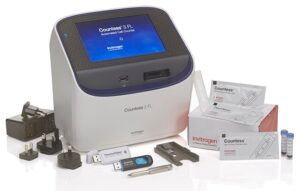
A grant application was compiled and submitted to the FACT and were delighted to receive a grant for £3000 which went a long way to meeting the cost of a cell counter, a start up kit and a three year warranty.
We cannot thank Felicity, the family and the Trust enough for their help in securing such a valuable piece of equipment for the project to use.
Research Overview – 2023
The GloBNHL trial is moving at speed. We had the launch meeting in Birmingham to bring together the US and Europe sides of things. Three companies onboard so far – Regeneron, ADC Therapeutics and Bristol Myers Squibb – first children should be recruited to the trial in the New Year if not before.
Jamie is still with us – he has a contract for another year and is finishing up the Queen Bee story – the COVID interruption meant we had to start everything from scratch and it proved difficult to repeat everything Sorcha did.
Science is just like that sometimes, different hands get different results and so we have been trying to work out why and to come to a conclusion that fits all the data.
Chris has been taking a different, but complimentary approach to the Queen Bee route – he has been labelling every cell within the tumour with a bar code so that we can track them through treatment. His early data are promising but he has been optimising the approach in vitro – we now need to move this into the mouse xenografts. This is technically challenging but then anything worth doing is never easy!
The Cell Counter is worth its weight in gold! It is getting a lot of use, and we are very happy that we have it.
Kind Regards
Suzanne
Professor Suzanne D. Turner PhD.
DEPARTMENT OF PATHOLOGY,
DIVISION OF CELLULAR AND MOLECULAR PATHOLOGY
UNIVERSITY OF CAMBRIDGE
Chris Steele
Last year we made significant progress by adding to our Patient Derived Xenograft (PDX) resource, these are tumours directly taken from patients and are maintained within the lab, thus allowing us to study the growth of real human tumours.
In particular,we developed PDX from four children whose tumours had become resistant to chemotherapy and had relapsed. As we know, it is rare for children with B Cell Lymphomas to become resistant to chemotherapy but if they do, as was the case for Alex, there is currently no cure.
As such, it is important that we study these rare resistant tumours to find new approaches to treatment.
These models are considered the gold standard for their clinical relevance and represent an invaluable resource for uncovering drug resistance mechanisms. Now that we have these models, I’m really excited about the data our work will generate this year and the potential clinical implications thereof.
We have a strong workflow planned for 2024 that involves the use of cutting-edge genetic engineering technologies to probe tumour behaviour in these drug resistant models. These technologies are extremely challenging to implement in xenograft models and have required a significant amount of optimisation and development to bring them into play. I am delighted to say that we have now robustly demonstrated that our novel experimental strategies perform effectively and efficiently. It is now time to fully implement these techniques on a large scale in each of our relapse cancer models.
The first strategy uses novel genetic engineering approaches to disrupt expression of genes that might be involved in drug resistance directly in our xenograft models, in growing human tumours, something that has not been done before. These experiments will answer some long-standing questions about whether these drug-resistant tumours depend on these genes for growth.
Our second approach uses genetic “barcodes” to uniquely tag each individual cell in our xenograft tumours. We can then track the individual cells throughout treatment to find out which ones survive through the therapy and are responsible for relapse.
We then will characterise these “relapse initiating cells” so that we can design specific treatment approaches.
Work of this nature has never been done before in relapsed childhood B cell lymphoma and it has only been possible with the support of the Alex Hulme Foundation.
Thank you so much to all the donors to the Alex Hulme Foundation, without you this devastating disease would lack the research attention it desperately deserves.
I look forward to updating you all next year on what we discover throughout the year.
Best wishes
Chris